

The “Mr. Kebab vs Mister Kebap” Case: How EU Courts Assess Likelihood of Confusion Between Trademarks
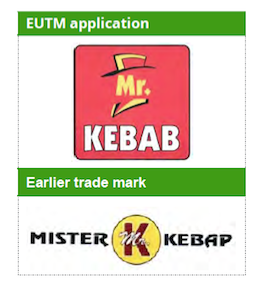
In a 2017 decision, the EU General Court (GC) confirmed that the trademarks “Mr. Kebab” and “Mister Kebap” — applied for similar food service businesses — were sufficiently similar to create a likelihood of confusion among consumers. The decision is a useful case study for understanding how EU trademark law evaluates trademark conflicts under Article 8(1)(b) EUTMR (now Regulation 2017/1001), through the so-called “global appreciation” test covering visual, aural, and conceptual similarity.
This guide explains the case and the broader framework for trademark conflict assessment, with attention to Italian and EU practice. For the broader copyright framework, see our master pillar guide to copyright law in Italy and Europe. For trademark genuine use, see our Lambretta case study.
In this guide
The case in brief
The case concerned an opposition before EUIPO (then OHIM): a proprietor of an earlier “Mr. Kebab” trademark opposed a later application for “Mister Kebap” for similar food services. The EUIPO Opposition Division initially considered the matter; the Board of Appeal (BoA) and ultimately the General Court reviewed the findings.
The Board of Appeal concluded that the signs were similar overall. The General Court, reviewing the BoA’s analysis, confirmed:
- The dominant elements of both signs were “Mr. Kebab” and “Mister Kebap”;
- These elements were distinctive within their commercial context;
- The figurative elements of both signs emphasised the meaning of the word elements rather than creating independent distinctiveness;
- The figurative elements were not particularly striking;
- The signs were visually similar;
- The signs were aurally similar to a very high degree;
- The signs were almost identical conceptually for consumers who understood the verbal elements;
- A likelihood of confusion existed.
Article 8(1)(b) EUTMR: the framework
Under Article 8(1)(b) of Regulation 2017/1001 (current EUTMR), an earlier trademark blocks registration of a later trademark where:
- The marks are identical or similar;
- The goods or services are identical or similar;
- There is a likelihood of confusion among the relevant public.
The likelihood of confusion includes the risk that consumers may believe the goods come from the same undertaking or economically linked undertakings — even where direct confusion of the marks themselves does not occur.
The global appreciation test
The CJEU has consistently held — across decades of case law from SABEL v Puma (C-251/95, 1997) onwards — that the likelihood of confusion must be assessed through a “global appreciation” considering:
- All relevant factors: similarity of marks, similarity of goods/services, distinctive character of the earlier mark, attentiveness of relevant consumers;
- Interdependence of factors: a lesser degree of similarity in goods/services can be offset by a greater degree of similarity in marks (and vice versa);
- Perception of the relevant consumer: the average consumer of the goods or services in question, generally considered reasonably well-informed, observant, and circumspect;
- Imperfect recollection: consumers rarely have the opportunity to make direct comparisons — they rely on imperfect memory.
The “global” nature of the test means no single factor is decisive; the overall impression matters.
Visual, aural, conceptual similarity
The similarity assessment considers three dimensions simultaneously:
Visual similarity
How similar do the marks look? Considers:
- Sequence of letters or graphic elements;
- Length of the marks;
- Distinctive design features;
- Position of dominant elements within the marks.
In Mr. Kebab/Mister Kebap, the visual similarity was strong: similar structure (“Mr.” / “Mister” + similar food term), comparable presentation.
Aural similarity
How similar do the marks sound when pronounced? Considers:
- Syllable count and rhythm;
- Phonetic correspondence of letters and sounds;
- Differences in articulation between languages of the relevant public.
The GC found aural similarity at a “very high degree” — the differences between “Kebab” and “Kebap” are minimal when spoken, and “Mr.” and “Mister” sound essentially identical.
Conceptual similarity
How similar are the marks in meaning? Considers:
- Semantic content of words;
- Mental associations evoked;
- Variation across linguistic segments of the relevant public.
The GC found conceptual similarity “almost identical” for consumers understanding the verbal elements — both signs evoke a male personification associated with kebab food service. For consumers not understanding the verbal elements, conceptual comparison was not possible — but the strong visual and aural similarity was sufficient.
Distinctive character vs similarity
A separate but related question: when the earlier mark has weak distinctive character, does that change the analysis?
The GC made an important didactic point: while the distinctive character of the earlier trademark is a factor in the analysis, it is only one factor among others. If distinctive character were given excessive weight:
- Weak earlier marks would be protected only against near-identical copying;
- The similarity-of-marks analysis would be effectively eliminated;
- Trademark owners with descriptive but valid registrations would lose meaningful protection.
This is contrary to the global appreciation framework: even a weak earlier mark deserves protection where the similarity of the contested mark would cause consumer confusion. Article 8(1)(b) EUTMR requires the integrated assessment, not a hierarchy where distinctive character dominates.
Italian framework
Italian trademark law applies parallel principles through:
- Article 12 of the Italian Industrial Property Code (D.Lgs. 30/2005): trademark conflict assessment based on similarity of signs and goods/services, with attention to likelihood of confusion;
- Article 20 CPI: trademark protection scope and infringement test;
- Italian implementation of the Trademark Directive (now Directive 2015/2436);
- UIBM opposition procedures (Italian national trademarks);
- EUIPO opposition procedures (EU trademarks).
Italian and EU practice converge on the global appreciation framework. For dual-system filings (Italian national + EU), opposition strategy needs coordinated assessment across both venues.
Practical lessons for trademark applicants
The Mr. Kebab/Mister Kebap case offers concrete lessons:
- Pre-application clearance: comprehensive trademark search across EU and national registers before filing is essential. Minor variations (“Kebab” vs “Kebap”, “Mr.” vs “Mister”) are unlikely to overcome existing registrations;
- Figurative elements rarely save weak word marks: where the word elements are similar, adding figurative elements that “emphasise the meaning” does not differentiate;
- Aural similarity is often decisive: marks that sound similar when spoken are typically found similar regardless of visual differences;
- Conceptual similarity bridges linguistic differences: even where consumers do not understand the verbal elements, conceptual associations carry through translation;
- Don’t rely on weak distinctive character defence: arguing that the earlier mark has weak distinctive character rarely succeeds against confusion claims;
- Industry context matters: food service marks are often weak in distinctive character because of descriptive terms, but enforcement remains robust.
How DANDI supports trademark owners
DANDI.media supports Italian and international trademark owners and applicants on EU and Italian trademark matters:
- Pre-filing trademark clearance and freedom-to-operate searches;
- EU trademark application and Italian UIBM filings;
- Opposition strategy and representation at EUIPO and UIBM;
- Defence against opposition proceedings;
- General Court and CJEU appeal representation;
- Trademark portfolio audit and risk assessment;
- Cross-border enforcement and litigation.
For consultation, book directly with Avv. Claudia Roggero or Avv. Donato Di Pelino.
Related guides
| Topic | Resource |
|---|---|
| Copyright Law in Italy and Europe (master pillar) | /en/copyright-law-italy-europe/ |
| Lambretta Trademark Case (genuine use) | /en/trade-mark-lambretta/ |
| Brand Identity Legal Protection | /en/brand-identity/ |
| Yoko Ono v. John Lemon (trademark) | /en/yoko-ono-sues-john-lemon/ |
| Parodying Fashion Labels (trademark parody) | /en/parodying-fashion-labels/ |
| Trade Secrets in Italy | /en/trade-secrets-in-italy/ |
Dandi Law Firm provides legal assistance in several Practice Areas. Check out our Services or contact Us!