
The Idea/Expression Dichotomy in Copyright Law: Italian and European Framework
One of the most fundamental and consequential principles of copyright law is the idea/expression dichotomy: the doctrine that copyright protects the original expression of an idea, but not the underlying idea itself. This deceptively simple distinction is the foundation of every copyright infringement analysis. It determines what creative elements receive monopoly protection and what remains free for others to use, develop, and build upon. It explains why two writers can write novels about star-crossed lovers (the idea) without infringing each other (the expression of that idea remains distinct), why a software programmer cannot copyright “an operating system” but can copyright the specific code, why an artist cannot prevent others from using fluorescent tubes in installations but may prevent the specific work being reproduced.
For artists, producers, content creators, and businesses operating in Italy and the European Union, understanding the idea/expression dichotomy and the closely related concept of the originality threshold is essential for both offensive and defensive copyright strategy: knowing what a competitor can use without infringing, and knowing what protection your own creative output actually carries.
This guide analyses the idea/expression dichotomy and the originality threshold under Italian and European copyright law, with attention to the foundational provisions of Italian Copyright Act Articles 1 and 2, the CJEU jurisprudence harmonising originality across the EU (notably Infopaq C-5/08, 2009 and Painer C-145/10, 2011), the comparative US framework including the merger doctrine, the application of the dichotomy to AI-generated content, and the practical implications across creative sectors. The famous Rihanna v. Clar case (Tribunal de Grande Instance de Paris, 2016) is analysed as illustrative case study. For the broader copyright framework, see our master pillar guide to copyright law in Italy and Europe. For the parallel discussion of what falls outside copyright entirely, see our guide to what is not protected by copyright.
In this guide
- The idea/expression dichotomy defined
- The Italian legal foundation: Articles 1 and 2 LDA
- The originality threshold under Italian and EU law
- CJEU harmonisation: Infopaq, Painer, and the EU originality test
- The US comparative framework and merger doctrine
- Case study: Rihanna v. James Clar (Paris 2016)
- Application across creative sectors
- The dichotomy in the age of AI
- When ideas need protection: alternatives to copyright
- Strategic implications for creators and businesses
- Frequently asked questions
- How DANDI supports clients on originality and protection scope
- Resources and useful links
The idea/expression dichotomy defined
The idea/expression dichotomy holds that copyright law protects the specific original expression of an idea — the particular words chosen, the specific musical notes arranged, the precise visual composition, the actual lines of code — but not the underlying idea, concept, procedure, process, system, method of operation, or discovery that the expression embodies.
Two consequences flow from this principle:
- What is protected: the actual creative work in its concrete form. A novel’s specific text, a song’s specific melody and lyrics, a film’s specific scenes and dialogue, a sculpture’s specific shape and execution, a software’s specific code;
- What is not protected: the ideas, concepts, themes, plots, character archetypes, scientific theories, mathematical formulas, business methods, recipes, and other abstractions that the work embodies or expresses.
Consider Romeo and Juliet: the general idea of star-crossed lovers from rival families is not protected. Anyone can write a story, podcast, song, or film based on that idea — Shakespeare himself worked from earlier sources, and West Side Story, Romeo + Juliet, and countless other works have used the same idea legitimately. What is protected is Shakespeare’s specific dialogue, his specific characters, his specific scene structure. Copying that constitutes infringement.
The same principle applies to procedures, processes, systems, methods of operation, concepts, principles, and discoveries. Their expression in writing or other creative form may be copyrightable; the underlying ideas, however, may be freely reproduced and built upon by anyone, without violating copyright law. (Other legal frameworks — patents, trade secrets, unfair competition — may protect the underlying idea, but copyright does not.)
The Italian legal foundation: Articles 1 and 2 LDA
Italian copyright law establishes the idea/expression dichotomy through the foundational provisions of Articles 1 and 2 of Law no. 633/1941 (the Italian Copyright Act, hereinafter “LDA”):
Article 1 LDA provides that the law protects “opere dell’ingegno di carattere creativo” — works of the intellect of a creative character — belonging to the domains of literature, music, figurative arts, architecture, theatre, and cinematography, regardless of the mode or form of expression. The provision establishes that what receives protection is the work as a creative expression, not the underlying idea.
Article 2 LDA then provides a non-exhaustive list of specific protected categories, illustrating that protection attaches to concrete works in identifiable form:
- literary, dramatic, scientific, educational, religious works;
- musical works with or without words, musical compositions;
- choreographic works and mimic works;
- works of sculpture, painting, drawing, engraving, and the like;
- architectural drawings and works;
- cinematographic works and audiovisual works;
- photographic works and works expressed through procedures analogous to photography;
- computer programs;
- databases (where selection or arrangement is the author’s own intellectual creation);
- industrial design works of artistic value.
Each category points to a concrete expression — a written text, a recorded performance, an executed visual work, a coded program — not to the abstract idea behind it. The Italian Court of Cassation has consistently held that copyright protects the form of expression and not the content of the idea, the historical fact, the scientific discovery, or the procedure described.
The principle is reinforced by Italian doctrine: copyright protection arises only where the work has creative character (carattere creativo), meaning that the author has exercised creative choices in giving the work its specific form. Where the form is dictated by function, by industry convention, by technical necessity, or by the underlying idea itself, copyright protection may be unavailable or extremely narrow.
The originality threshold under Italian and EU law
The idea/expression dichotomy is operationalised through the originality threshold: the level of creative input required for a work to qualify for copyright protection. The threshold varies somewhat across categories of works and jurisdictions, but Italian and EU law have converged on a relatively low but meaningful threshold: the work must reflect the author’s own intellectual creation, expressing creative choices that distinguish it from mere mechanical or routine production.
Italian courts apply the originality threshold flexibly, with attention to:
- Creative choices: did the author make choices in expressing the work that reflect personal creativity?
- Distinctiveness from prior art: does the work differ from existing works in ways attributable to the author’s creative input?
- Sufficient creative contribution: even small contributions can qualify, but truly mechanical, dictated-by-function, or routine output may not;
- Category-specific application: photography, software, databases, and certain functional works have their own calibrated originality tests.
The threshold is not a quality judgment — works of modest artistic merit can qualify for copyright protection if they reflect creative choices. A simple drawing, a short poem, a brief song, a minimal photograph can all be protected if originality is present. Conversely, even technically complex output may lack copyright protection if it consists of mechanical execution without creative choice.
CJEU harmonisation: Infopaq, Painer, and the EU originality test
The Court of Justice of the European Union has progressively harmonised the originality threshold across EU member states through a series of landmark decisions. The two foundational cases:
Infopaq (C-5/08, 2009)
In Infopaq International A/S v. Danske Dagblades Forening, the CJEU addressed whether short extracts from newspaper articles (11 words at a time) could qualify for copyright protection. The court held that copyright under EU law applies to material that is the author’s “own intellectual creation” — establishing a unified EU originality test that applies regardless of the work’s category or national legal tradition.
The Infopaq test: a work or part of a work qualifies for copyright protection if it reflects the author’s intellectual creation through expressing personal touches in their creative work. The threshold is relatively low — even short extracts can be protected if they express the author’s intellectual creation — but it is meaningful: pure facts, pure data, mechanical compilations, and routine output do not qualify.
Painer (C-145/10, 2011)
In Eva-Maria Painer v. Standard VerlagsGmbH and Others, the CJEU applied the Infopaq test to photographs, specifically portrait photographs of Natascha Kampusch used in news reports following her escape from captivity. The court held that portrait photographs can constitute “intellectual creations of the author” where the photographer has made free and creative choices in setting the scene, choosing the pose, lighting, framing, angle, and the specific moment captured.
The Painer framework: even photographs of real subjects in unstaged contexts can qualify for copyright protection if the photographer exercised free creative choices, regardless of artistic merit or technical sophistication. The court emphasised that the originality threshold applies uniformly across categories of works.
Subsequent CJEU jurisprudence — Football Dataco (C-604/10, 2012), SAS Institute (C-406/10, 2012), Cofemel (C-683/17, 2019), and others — has further developed the originality framework across specific categories, generally reinforcing the Infopaq test while addressing specific issues (databases, software interfaces, design works).
For Italian and broader EU copyright analysis, the CJEU framework is now binding. National courts apply the Infopaq/Painer originality test even where national law previously had a different threshold. The threshold is unified, with national variations limited to specific categories where EU directives provide differentiated rules.
The US comparative framework and merger doctrine
The US copyright framework recognises the idea/expression dichotomy under Section 102(b) of the US Copyright Act (17 U.S.C. § 102(b)):
“In no case does copyright protection for an original work of authorship extend to any idea, procedure, process, system, method of operation, concept, principle, or discovery, regardless of the form in which it is described, explained, illustrated, or embodied in such work.”
The US framework also includes the merger doctrine: where an idea can only be expressed in a very limited number of ways, the expression “merges” with the idea and copyright protection is denied or narrowed. The classic example is a simple instruction or factual description: there are only so many ways to explain how to tie a knot, so each individual expression of that explanation receives narrow or no protection.
The merger doctrine has applications in:
- Functional works: where form is dictated by function, expression may merge with idea;
- Technical descriptions: instructions, formulas, and technical specifications;
- Stock characters and plot elements: highly conventional creative elements (scenes à faire);
- Simple visual elements: basic geometric shapes, primary colours, simple compositions.
Italian and EU law applies similar principles through the originality threshold rather than through a separately articulated merger doctrine. Where expression is dictated by function, by industry convention, or by the underlying idea itself, the originality threshold may not be met, with the same practical result as US merger doctrine application.
Comparative table
| Element | Italian/EU Law | US Law |
|---|---|---|
| Idea/expression dichotomy | Embedded in Articles 1-2 LDA; CJEU jurisprudence | Express in 17 U.S.C. § 102(b) |
| Originality threshold | Author’s own intellectual creation (Infopaq/Painer) | Minimum degree of creativity (Feist v. Rural Telephone, 1991) |
| Merger doctrine | Embedded in originality analysis | Express doctrine |
| Scenes à faire | Conventional elements lack originality | Doctrine of scenes à faire |
| Useful articles | Article 2(10) LDA on design of artistic value | Section 101 useful article doctrine |
The practical outcomes are similar across the two systems for most cases, but the doctrinal framework differs. For cross-border productions and IP transactions, the differences matter at the margins — where a US merger doctrine analysis might produce a clearer “no protection” outcome than an Italian originality analysis, or vice versa.
Case study: Rihanna v. James Clar (Paris 2016)
The Rihanna v. Clar case offers a useful illustration of how the idea/expression dichotomy operates in practice across creative sectors and jurisdictions.
The facts
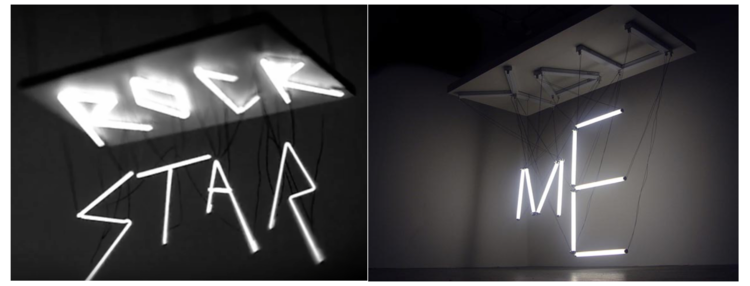
James Clar, a New York-based visual artist who uses technology as a medium for installations critiquing the dissociative effects of technology, exhibited a work titled “You and Me” in Memphis in 2006. The installation consisted of suspended fluorescent tubes arranged to form words.
In 2010, Rihanna released the music video for “Rockstar 101”, which opened with shots of a neon light installation including the words “Rock star” composed in fluorescent tubes suspended from a ceiling.
In June 2014, Clar filed a copyright infringement suit against Rihanna in France, seeking €4.9 million in damages (the equivalent of €0.10 for each viewing of the allegedly infringing video). Clar argued that the installation in Rihanna’s video was a “straight lift” from his 2006 Memphis exhibition.
The decision
The Tribunal de Grande Instance de Paris, in November 2016, dismissed Clar’s claim. The court acknowledged that there were similarities between Clar’s work and the opening scene of Rihanna’s video — both involved words formed from suspended fluorescent tubes — but held that those similarities were outweighed by the differences, and that the similarities at the level of the general visual concept did not constitute copyright infringement.
The court also dismissed Rihanna’s counterclaim for $100,000 in damages, which had argued that Clar’s lawsuit was meritless and abusive. The court maintained neutrality, finding the suit raised legitimate questions even though the merits did not support liability.
Doctrinal analysis
The case illustrates the idea/expression dichotomy in operation in the visual arts context:
- The general concept — using suspended fluorescent tubes to form words as an artistic installation — is an idea, a technique, a method. It is not protected by copyright. Many artists have used fluorescent tubes as a sculptural medium since Dan Flavin pioneered the approach in the 1960s, and many have used letters formed from various materials;
- The specific work — Clar’s “You and Me” installation with its particular composition, specific words, specific arrangement, specific aesthetic execution — could be protected by copyright, but only against substantial copying of that specific work, not against general use of the underlying concept;
- The differences between the works — different words, different arrangement, different context, different visual aesthetic — were sufficient to fall outside the scope of protection of Clar’s specific work;
- Idea vs expression: Clar could not, through copyright, monopolise the technique of using fluorescent tubes to form words. Any artist or production designer remains free to use that technique, provided they do not substantially reproduce Clar’s specific work.
The Rihanna case represents standard application of the idea/expression dichotomy. The outcome would likely have been similar under Italian and broader EU jurisprudence, and probably under US law as well. The general visual concept (technique, medium, broad idea) does not receive copyright protection; only the specific creative expression does.
Clar’s reaction following the decision — “All my work is filed with copyright office now” — reflects a common misunderstanding: filing or registration does not extend copyright protection to ideas and concepts. Registration provides evidentiary benefits but does not change the substantive scope of what copyright protects.
Application across creative sectors
Literary works: plots and characters
In literature, the idea/expression dichotomy plays out across several recurring scenarios:
- Plots and themes: general plot structures (boy meets girl, hero’s journey, rags-to-riches) are not protected. Specific plot elements, dialogue, and narrative execution are;
- Stock characters: archetypal characters (the mentor, the trickster, the femme fatale) are not protected; specific characters with developed personalities, names, traits, and arcs can be;
- Genre conventions: the conventions of mystery, romance, science fiction, fantasy are not protected; specific creative choices within those genres are;
- Historical and factual elements: historical events, real people, factual contexts are not protected; specific narrative treatment of those elements can be.
Italian and EU courts apply the dichotomy with attention to the cumulative effect of multiple similar elements. A single similarity at the idea level (similar plot) is insufficient; substantial similarities across specific creative expression (similar specific scenes, similar specific dialogue, similar specific character names and traits) can establish infringement.
Music: melodies, motifs, and styles
Music applies the dichotomy with category-specific complexity:
- Musical styles and genres: rock, jazz, country, hip-hop — not protected. Anyone can compose in any style;
- Common musical elements: chord progressions, scales, rhythms, common riffs — generally not protected, particularly when widely used in the genre;
- Specific melodies: distinctive melodic lines can be protected, but only against substantial reproduction. The Italian and EU framework on sampling (post-Pelham 2019) is particularly strict on master recordings (see our music sampling law analysis);
- Lyrics: protected at the level of specific expression. Common phrases and short expressions are typically not protected on their own.
Visual arts: styles and concepts
The Rihanna case illustrates the framework in visual arts:
- Artistic styles and movements: impressionism, cubism, conceptual art — not protected. Style is freely available to other artists;
- Techniques and media: fluorescent tubes, screen printing, photographic processes — not protected;
- Specific works: the specific composition, execution, and aesthetic choices of an individual work can be protected against substantial reproduction;
- Concepts and ideas in conceptual art: this is one of the most contested areas, with the conceptual content of works receiving very limited protection.
Film and television: scenes à faire
Film and television apply the dichotomy with particular attention to “scenes à faire” — scenes that flow naturally from the chosen setting, genre, or subject matter and are therefore not protected:
- Genre conventions: action sequences, romantic scenes, courtroom drama set-pieces are scenes à faire of their respective genres;
- Necessary scenes: a war film typically requires battle scenes; a heist film typically requires a planning scene. These standard structural elements are not protected;
- Specific creative execution: the way specific scenes are written, shot, performed, edited — this can be protected against substantial copying.
For audiovisual co-authorship and the broader chain of title context, see our guide to copyrightable elements in film.
Software: methods, interfaces, and code
Software has its own particular framework under Directive 2009/24/EC and Articles 64-bis ff. LDA:
- Specific code: protected as literary work;
- Methods and algorithms: not protected by copyright (potentially patentable in some jurisdictions, but copyright excludes them);
- Functional aspects: not protected (functional output flows from the idea, not from creative expression);
- Interfaces and APIs: contested area. CJEU SAS Institute (C-406/10) excluded programming languages, instruction sets, and certain interface elements from copyright protection;
- User interfaces (graphic): may be protected as artistic works where creative choices in design are present.
Fashion and design: utility and expression
Fashion and design occupy a difficult intersection of utility and creative expression:
- Functional clothing: typically not protected by copyright (functional articles);
- Design with artistic value: under Article 2(10) LDA, industrial design works of artistic value can be protected;
- Specific creative elements: distinctive patterns, prints, and decorative features can be protected;
- Design registration: industrial design registration under D.Lgs. 30/2005 provides separate, complementary protection;
- CJEU Cofemel (C-683/17, 2019): held that originality is the only criterion for copyright protection of design works — separate “artistic value” requirements at national level are incompatible with EU law to the extent they exclude works meeting the originality threshold.
The dichotomy in the age of AI
The idea/expression dichotomy takes on new dimensions in the age of AI-generated content. The EU AI Act (Regulation 2024/1689), Italian Law 132/2025 on artificial intelligence, and emerging CJEU jurisprudence are reshaping the framework:
Authorship of AI-assisted works
Under Italian and EU copyright, protection requires human authorship — the work must be the “author’s own intellectual creation”. This generates several practical scenarios:
- Purely AI-generated works: where the human input is limited to a prompt or instruction, the resulting AI output typically does not qualify for copyright protection. The AI’s output is not human intellectual creation; the prompt typically does not contain sufficient creative expression to itself be protected;
- AI-assisted works with substantial human creative input: where the human author exercises substantial creative control over the work (curating outputs, modifying generated content, integrating AI output into a broader creative work shaped by human choices), copyright protection can attach to the human-authored work as a whole;
- The originality threshold applied to AI output: the analysis turns on whether the work reflects human intellectual creation through expressing personal touches, applying the Infopaq test. Pure AI generation does not satisfy this; substantial human creative input can.
Training data and the dichotomy
Where AI models are trained on copyrighted works, the idea/expression dichotomy interacts with the text and data mining exceptions of DSM Articles 3 and 4. The training process extracts patterns and statistical relationships (ideas, in a sense) from the training works, then generates new output. The legal analysis is active across multiple jurisdictions:
- where AI output reproduces specific copyrighted expressions from training data, copyright infringement claims may apply;
- where AI output expresses ideas, styles, or patterns extracted from training data without reproducing specific expressions, the dichotomy may protect the AI output (in the sense that no infringement occurs);
- but the question of whether the training itself constitutes infringement (separate from the AI output) is contested and subject to evolving case law.
AI generating in the “style” of an identified author
The classic dichotomy holds that style is not protected. AI-generated content in the style of an identifiable author would, on traditional dichotomy analysis, fall outside copyright. However:
- Personality rights (Italian Civil Code Article 10) may apply where AI clones an identifiable artist’s voice, image, or distinctive identity;
- Moral rights may be triggered where AI imitation creates content that prejudices the original author’s honour or reputation;
- EU AI Act transparency obligations: commercial AI-generated content typically requires labelling and disclosure under the Regulation 2024/1689 framework;
- Unfair competition: where AI imitation creates marketplace confusion or deceptive presentation, unfair competition law may apply.
The traditional idea/expression dichotomy thus interacts with multiple newer legal frameworks in the AI context, producing a more complex analysis than the pure copyright framework alone.
When ideas need protection: alternatives to copyright
Where ideas, concepts, methods, or systems need legal protection — and copyright cannot provide it — other intellectual property frameworks may apply:
- Patents: for inventions meeting novelty, inventive step, and industrial application criteria. Italian patents through UIBM and European patents through EPO. Patents protect the underlying invention, not just its specific expression;
- Trade secrets: for confidential business information of commercial value. Italian protection under D.Lgs. 63/2018 (transposing EU Directive 2016/943);
- Trademarks: for distinctive signs identifying commercial origin. Italian trademarks through UIBM, EU trademarks through EUIPO;
- Industrial design: for the aesthetic of products under D.Lgs. 30/2005. Different from copyright but can be complementary;
- Database sui generis right: under Directive 96/9/EC, for databases reflecting substantial investment (separate from copyright protection of original databases);
- Unfair competition: under Italian Civil Code Article 2598 and EU rules, for misleading or parasitic practices;
- Personality rights: under Article 10 Italian Civil Code, for image, name, and likeness;
- Contractual protection: for confidential information shared under non-disclosure or contractual confidentiality obligations.
For an operational checklist of what specifically falls outside copyright protection, see our guide to what is not protected by copyright.
Strategic implications for creators and businesses
The idea/expression dichotomy has direct strategic implications:
For creators
- Document your creative process: evidence of original creative choices supports both the originality threshold and integrity defences against later infringement claims;
- Distinguish ideas from expression in pitches: when pitching ideas, recognise that the idea itself is not protected — use NDAs and contractual frameworks where necessary;
- Build distinctive expression around common ideas: most creative work builds on existing ideas; what matters is the specific creative execution;
- Combine copyright with other IP: where the underlying idea has commercial value, consider patent, trademark, or trade secret protection alongside copyright;
- Be cautious of “I’ll show you and we’ll discuss” pitches: once you share an idea without protection, the recipient can develop competing work based on the idea (provided they don’t copy your specific expression).
For businesses and producers
- Clearance analysis: when commissioning or acquiring creative work, distinguish between protected expression (must be cleared) and underlying ideas (free to use);
- Competitor analysis: where competitors have produced creative work, the specific expression is off-limits but the underlying ideas, concepts, and techniques are generally available;
- Risk assessment: substantial similarity at the idea level rarely supports infringement claims; substantial similarity at the expression level can;
- Documentation of independent creation: in any potential dispute, evidence of independent creation supports the position that any similarities reflect common ideas rather than copying.
For licensors and licensees
- Define scope precisely: licences should be clear about what specific expression is covered (and what underlying ideas remain free);
- Address derivative works: derivative rights extend to elaborations of the specific expression, not to free use of underlying ideas;
- Consider scope of restriction: non-compete clauses cannot prevent licensees from using public domain ideas; they can only restrict use of specific licensed expression.
Frequently asked questions
What does the idea/expression dichotomy mean?
Copyright protects the specific original expression of an idea — the actual words, music, images, or code — but not the underlying idea itself. The principle is embedded in Articles 1 and 2 of the Italian Copyright Act and is harmonised across the EU through CJEU jurisprudence. Anyone can use the same idea; only the specific creative expression is protected.
What is the originality threshold under Italian and EU law?
A work qualifies for copyright protection when it reflects the author’s “own intellectual creation” — meaning the author has exercised creative choices in expressing the work. The standard was harmonised across the EU through CJEU Infopaq (C-5/08, 2009) and Painer (C-145/10, 2011). The threshold is relatively low but meaningful: routine, mechanical, or purely functional output may not qualify.
Can I write a novel about star-crossed lovers without infringing Romeo and Juliet?
Yes. The general idea of star-crossed lovers from rival families is not protected. Shakespeare’s specific dialogue, characters, and scene structure are. As long as you create your own specific expression, you can build on the same underlying idea — as countless successful adaptations have done.
Are styles and techniques protected by copyright?
No. Artistic styles (impressionism, cubism, conceptual art) and techniques (fluorescent tube installations, particular brushstrokes, particular musical genres) are not protected by copyright. Only specific creative expressions within those styles are protected. The Rihanna v. Clar case (Paris 2016) confirmed this in the visual arts context.
What is the merger doctrine and does it apply in Italy?
The merger doctrine — where an idea can only be expressed in very limited ways, the expression “merges” with the idea and protection is denied — is explicit in US law. Italian and EU law applies similar principles through the originality threshold: where expression is dictated by function or by the idea itself, originality may not be met. The practical outcomes are similar across the two systems.
Can AI-generated work qualify for copyright protection?
Purely AI-generated work without substantial human creative input does not qualify under Italian and EU copyright law, which requires human intellectual creation. AI-assisted work with substantial human creative input (curation, modification, integration into broader human-shaped work) can qualify. The Infopaq test applied to AI scenarios turns on whether human creative choices are sufficiently expressed in the work.
How can I protect an idea that copyright does not cover?
Through alternative IP frameworks: patents (for inventions), trade secrets (for confidential business information), trademarks (for commercial identifiers), industrial design (for aesthetic of products), database sui generis right (for substantial investment in databases), unfair competition law, personality rights, and contractual frameworks (NDAs, confidentiality agreements).
What are scenes à faire?
Scenes à faire are scenes that flow naturally from the chosen setting, genre, or subject matter — for example, a battle scene in a war film, a planning scene in a heist film. They are not protected by copyright because they constitute necessary or conventional elements that any author working in the genre would use. Only the specific creative execution of such scenes can be protected.
Was the Rihanna case decided correctly under the idea/expression dichotomy?
Yes, under standard application of the principle. The general visual concept of words formed from suspended fluorescent tubes is an idea/technique, freely available to artists. Clar’s specific 2006 installation could be protected against substantial reproduction, but the differences between his work and the Rihanna video opening meant the protection of his specific work was not infringed.
How does the originality threshold differ from category to category?
The CJEU has progressively harmonised the originality threshold (Infopaq, Painer, SAS Institute, Football Dataco, Cofemel) across categories, with the unified test being “author’s own intellectual creation”. National variations remain for specific categories where EU directives provide differentiated rules (databases, software, etc.). Italian Article 2(10) on industrial design works of artistic value interacts with CJEU Cofemel ruling.
How DANDI supports clients on originality and protection scope
DANDI.media supports Italian and international clients on the operational application of the idea/expression dichotomy and the originality threshold:
- Protection scope analysis: assessment of whether specific creative works qualify for copyright protection and the boundaries of that protection;
- Clearance and freedom-to-operate: analysis of whether new creative work infringes existing copyrighted works, with attention to the idea/expression boundary;
- Originality assessment: evaluation of works against the CJEU Infopaq/Painer threshold;
- Defence in infringement litigation: representation of defendants in copyright infringement claims, with emphasis on idea/expression dichotomy, originality threshold, scenes à faire, and merger arguments;
- Plaintiff representation: structuring infringement claims with appropriate focus on specific expression rather than ideas;
- Alternative IP strategy: combination of copyright with patent, trademark, design, and trade secret protection where ideas need legal protection beyond copyright;
- Style and concept protection: where styles, concepts, or distinctive presentations cannot be protected by copyright, exploration of personality rights, unfair competition, trademark, and contractual frameworks;
- AI originality questions: assessment of AI-assisted works for copyright protection, drafting of contracts addressing AI-related originality issues;
- Cross-border originality analysis: comparative analysis of originality thresholds across Italian, EU, US, UK, and other jurisdictions for international IP transactions.
For an initial consultation on originality, protection scope, or related copyright matters, book a consultation directly with Avv. Claudia Roggero or Avv. Donato Di Pelino via the booking links on this page.
Resources and useful links
Related guides in the copyright system
| Topic | Resource |
|---|---|
| Copyright Law in Italy and Europe — master pillar | /en/copyright-law-italy-europe/ |
| What is Not Protected by Copyright | /en/protecting-ideas/ |
| Moral Rights in Italy and Europe — hub | /en/moral-right/ |
| Civil Law vs Common Law Copyright | /en/copyright-ownership-film-chain/ |
| Copyrightable Elements in Film (Chain of Title) | /en/copyrightable-elements-film/ |
| Music Sampling Law (Pelham/VMG) | /en/vmg-salsoul-llc-v-madonna/ |
| Music Cover License | /en/music-cover/ |
| Copyright Duration and Pre-Existing Works | /en/big-bang-producers-can-sleep-soundly/ |
Primary legal sources
| Source | Link |
|---|---|
| Italian Copyright Act (Law 633/1941) | Normattiva |
| EU Copyright Directive (2001/29/EC) | Eur-Lex |
| EU Software Directive (2009/24/EC) | Eur-Lex |
| EU DSM Directive (2019/790) | Eur-Lex |
| EU AI Act (Regulation 2024/1689) | Eur-Lex |
| Italian AI Law (Law 132/2025) | Normattiva |
| CJEU jurisprudence (Infopaq, Painer, Cofemel, others) | curia.europa.eu |
| US Copyright Act | copyright.gov |
Dandi Law Firm provides legal assistance in several Practice Areas. Check out our Services or contact Us!